
Top 5 Time-Saving Tricks for IPMAT Preparation
- Nov 3, 2025
- 4 min read

Introduction
Preparing for the IPMAT (Integrated Program in Management Aptitude Test) can feel like a marathon, especially when you’re balancing school, boards, or other entrance tests. The truth? Every topper will tell you that time management is the ultimate game-changer.
This blog reveals the top 5 time-saving tricks for IPMAT preparation, carefully curated through expert insights, topper interviews, and proven success patterns. Whether you’re preparing for your first attempt or aiming to improve your score, these strategies will help you optimise every second of your prep.
Why Time Efficiency Matters in IPMAT Preparation
IPMAT is not just about intelligence; it’s about speed with accuracy. With limited time and tricky questions, even well-prepared students struggle to complete the test. The key lies in developing a structured, strategic approach to study smarter, not longer.
Unlike other management exams, IPMAT tests conceptual clarity and agility. Candidates often underestimate how fast 40 minutes can fly in the Quantitative and Verbal sections. If you don’t master time efficiency early, your accuracy won’t translate into higher scores.
That’s where this guide comes in, your roadmap to maximising output while cutting wasted effort.
Trick #1 – Master the 80/20 Rule in Your Study Plan
The Pareto Principle (80/20 Rule) applies perfectly to exam prep. Roughly 80% of your results come from 20% of your efforts. Identify the high-impact topics that carry the most weight in the exam and focus relentlessly on them.
Action Plan:
Review the IPMAT syllabus and mark recurring topics from previous years.
Dedicate 70% of your time to mastering key Quant and Verbal chapters (Arithmetic, Algebra, Grammar, RCs).
Use the remaining 30% to revise and tackle weaker areas.
Pro Tip: Combine topic-wise study with mock test feedback. It reveals which 20% of topics give you the biggest returns.
Trick #2 – The “One-Minute Rule” for Quant Questions
Many aspirants waste precious minutes overcomplicating Quant questions. The One-Minute Rule ensures you don’t get stuck. If you can’t solve a question within 60 seconds, flag it and move ahead.
You can revisit flagged questions later — often, your subconscious solves them while you continue.
Steps to Practice:
Set a one-minute timer for each question during practice sessions.
Track how many questions you solve accurately within that window.
Focus on increasing accuracy without exceeding the time limit.
This technique improves both speed and confidence essential for mastering IPMAT’s time-sensitive sections.
Trick #3 – Build “Micro Revision Slots” Into Your Routine
Instead of long revision blocks, break them into micro-revision sessions of 10–15 minutes. Review formulas, short notes, or RC tricks while travelling, waiting, or relaxing.
These bite-sized reviews create strong memory recall without feeling like study pressure.
Checklist for Micro-Revision:
Morning: Review 10 Quant formulas.
Noon: Read one RC passage and summarise it mentally.
Night: Revise vocab flashcards before sleeping.
Consistency is key. Over time, micro-revision builds long-term retention effortlessly.
Trick #4 – Leverage Mock Tests & Analyze Like a Pro
Mock tests aren’t just practice; they’re diagnostic tools. Every mock reveals patterns about your performance that no coaching class can replicate.
Here’s how to extract full value:
Take 1 full mock test every week during early prep.
In the last two months, the number of mocks has increased to 2–3 mocks weekly.
After each mock, analyse why you made each mistake.
Track your weak sections using spreadsheets or dashboards. You’ll quickly identify question types that drain time—and eliminate them from your weak areas.
A smart student learns from mistakes. A topper records, analyses, and acts on them.
Trick #5 – Train Your Brain for Split-Second Focus
Your brain’s attention span is a muscle, and it can be trained. During exam prep, simulate the actual IPMAT test environment.
Techniques:
Study in 45-minute focus bursts followed by 10-minute breaks.
Use Pomodoro timers to measure focus cycles.
Keep your phone away and practice deep work during mock hours.
By exam day, your brain automatically adjusts to IPMAT’s time rhythm, reducing panic and improving accuracy under pressure.
Bonus Trick – Smart Resource Optimisation
In today’s digital world, there’s no shortage of study material; the problem is overconsumption. Instead of using 10 random sources, stick to 2–3 reliable ones and revise them thoroughly.
Combine concise notes, topic-wise mocks, and expert classes from reputed platforms. This focused method helps you cover more with less effort — the real essence of efficiency.
Top online IPMAT coaching platforms provide structured modules that save hours of scattered research while offering insights that would take months to learn solo.
Cheat sheet: The Ultimate IPMAT Time-Saver List
Category | Time-Saving Hack | Benefit |
Study Plan | Apply 80/20 Rule | Focus on high-yield topics |
Practice | Use One-Minute Rule | Boost speed without losing accuracy |
Revision | Micro Sessions | Retain concepts with less stress |
Testing | Analyze Every Mock | Identify patterns early |
Focus | Pomodoro Cycles | Train your brain for exam rhythm |
How CAT Strategies Can Help You
Many aspirants preparing for IPMAT also target CAT in the future. Adapting techniques from Online CAT Coaching, such as sectional analytics, RC tactics, and reasoning frameworks, accelerates your learning curve. These cross-exam strategies help you internalise efficient study patterns that are transferable across management entrance tests.
The crossover between CAT and IPMAT prep allows you to evolve faster as a management aspirant, setting the tone for future success in exams like CAT, NMAT, or XAT.
The Importance of Staying Updated (and Logistics)
Every year, IPMAT introduces subtle changes in its pattern or question framing. Keeping track of official notifications and checking administrative timelines helps you stay exam-ready and stress-free. For students preparing multiple exams, it’s smart practice to note key exam dates and ensure all logistics are in order. For example, downloading your CAT Admit Card as soon as it’s released prevents last-minute panic and ensures you’re ready for any overlap in schedules.
Stay in sync with trusted education portals and official university websites to avoid surprises.
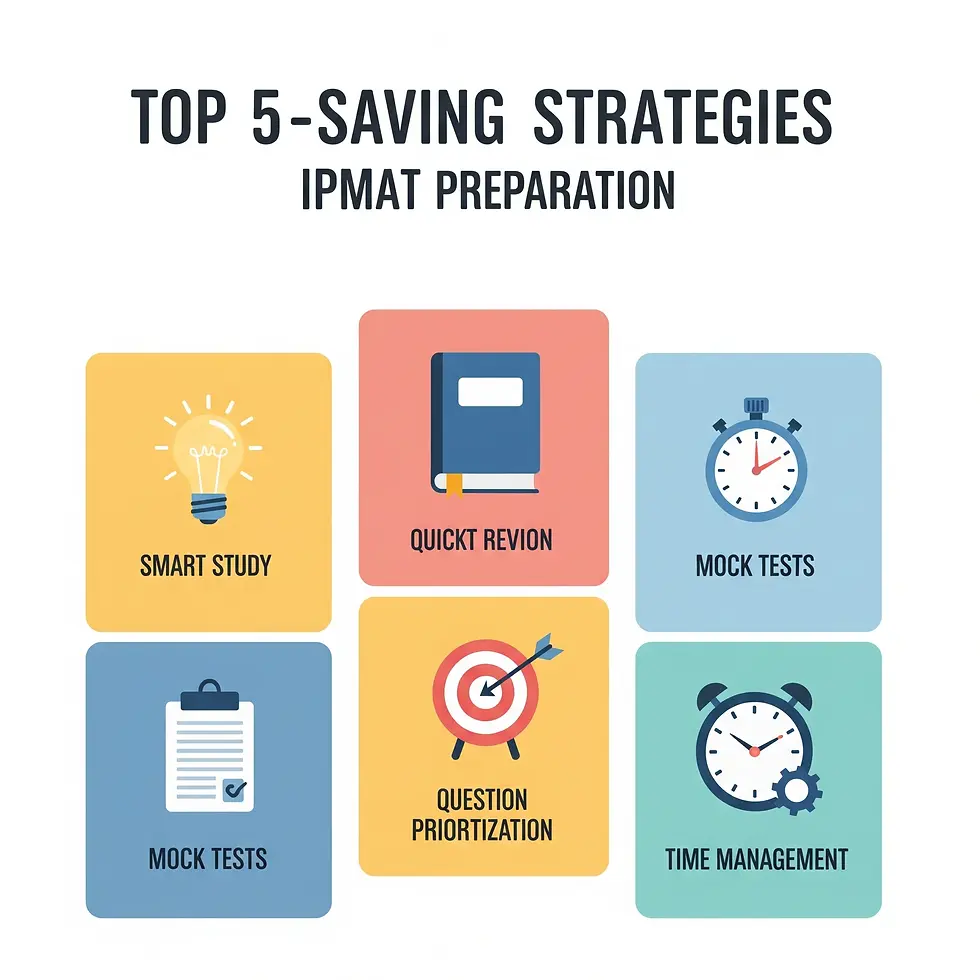
Cracking IPMAT isn’t about studying more; it’s about studying right. Each minute counts when you balance learning, mock tests, and revision.
By applying these five time-saving tricks consistently, you’ll not only optimise your prep but also build the mental agility required for management exams ahead.
Remember: toppers aren’t born; they plan smartly, execute consistently, and always learn from every mock.
Start today, and soon, efficiency will be your strongest skill.


Comments